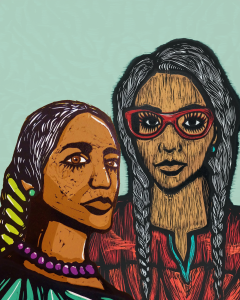
This past Spring, the Chicane & Latine Studies Program hosted two panels as part of its year-long Speaker Series on “Building Communities of Care and Resilience in Times of Crisis.” As a field grounded in histories of struggle and resistance, we wanted to encourage an open discussion on the myriad ways in which Latinx/e communities build resilience and engage in practices of care to survive, refuel, and continue fighting against injustices and abuses of power. Moreover, we wanted to give our students, staff, and faculty a message of hope and solidarity at a time when our communities are being attacked on multiple fronts—from ICE raids and mass deportations to restrictions on reproductive health care, labor rights, and education.
Our February panel on “Migration, Resilience, and Community Building in Times of Crisis,” focused on the resiliency of immigrants and displaced citizens as they navigate legal terrains, state bureaucracies, and a sense of belonging through community networks and placemaking. Sociologist Stephanie Canizales (UC Berkeley) drew on her ethnographic research with Maya Guatemalan youth in California to discuss how they engage in worldmaking and imagine futures through peer mentoring and support networks, helping them cope with various forms of racial and linguistic discrimination. Anthropologist Gina Pérez (Oberlin College) highlighted how inter-ethnic faith-based groups in Ohio engage in sanctuary practices and acompañamiento to aid and support undocumented immigrants, asylum seekers, and U.S. citizens displaced from Puerto Rico post-Hurricane Maria. Border scholar Gilberto Rosas (University of Illinois Urbana-Champaign) reflected on the various forms of violence experienced by border residents and asylum seekers in El Paso, Texas, and on the ways in which attorneys and community activists practice self-care to support the emotional toll of their advocacy work.
In April, we held our last panel on “Gender, Care Networks, and Social Justice,” focused on how Latina women organize, collaborate, and engage in practices of care as they advocate for their communities in areas of reproductive health, migration, and education. Anthropologist Patricia Zavella (UC Santa Cruz) used an intersectional and decolonial framework to examine how multigenerational Latina activists engage in local and national campaigns to fight for reproductive justice. She described how activists use workshops and storytelling to build community, raise consciousness, and support holistic forms of self-care. Anthropologist Anna Ochoa O’Leary (U Arizona) drew on her binational research in Arizona and Sonora to highlight the challenges and vulnerabilities that women migrants face as they attempt to cross the border undocumented. She also referenced the often-neglected history of mutual aid groups at the border and drew connections with contemporary NGOs and advocacy groups aiding migrants.
Both panels were well attended, in person or via Zoom, followed by rich conversations during Q&A. Based on audience comments and positive feedback, many of our students and attendees appreciated having this space to learn and reflect on the importance of our field in addressing and informing on contemporary social issues. These conversations echo those also happening at the national level with this year’s Latinx Studies Association Conference on “Together, We Stand Resilient” and the National Association for Chicana and Chicano Studies Conference on “Resistance and Re-existence.” I thus believe that in times like these, we cannot afford to be silent nor mere observers. We must use our platform and expertise to speak on the most pressing issues affecting our communities and interlocutors. If not now, when? If not us, who?
We would like to thank our speakers for sharing their expert knowledge and commitment to ethical practices and community-based research. We would also like to thank the Anonymous Fund and partner departments and programs for their financial contributions that helped make this series possible.
Spring 2026 Newsletter