On April 4th, 2026, CLS faculty and students took a field trip to Chicago to see two art exhibits. The first exhibit, titled “Rieles and Raíces,” was co-curated by an alumnus of the CLS Program, Ismael Cuevas (’10). Cuevas invited CLS faculty and students to come for a guided tour of the exhibit at the National Museum of Mexican Art in Chicago. Cuevas credits his experience with CLS with preparing him to work on this important exhibit. The second exhibit, located at the Museum of Contemporary Art in Chicago, was on the art of Dominican/Haitian artist Firelei Báez. This field trip was well-received by students and faculty alike. For CLS Student Karla Martinez, “Rieles and Raíces” confirmed for her “that collecting and preserving our stories is important in filling the archival gaps.” She further noted that the exhibit also revealed “the importance of average working people in history, and telling these stories is equally important as telling the stories of major figures, politicians, and athletes.” Alicia Lopez highlighted the inspiring nature of the exhibit, as “viewers of this exhibit can and should make connections between now and the past when it comes to the public framing of immigrants and immigrant work forces.” What she found most impactful about the exhibit was “the history of fluctuating views regarding immigrants—how at some moments they are needed but at other moments, they are unwanted.”CLS students were also inspired by Cuevas’ work on the exhibit. Adrian Angeles Ordoñez noted that what he appreciated about viewing “Rieles and Raíces” was “Ismael Cuevas’s story of creating the exhibit, how he brought the research story to life in the exhibit.” Alexa Iraheta praised the exhibit as “a beautiful commemoration to Latine railroad workers in the U.S.” She further complimented how the exhibit “honored the women and families who were the glue to making this exhibit possible because they were the ones who had kept these records, photos, etc.” After her experience on the field trip, she encourages “all museum goers to ask where the archives come from because the source is just as important as the archival material.” This field trip was enjoyed by all who had the opportunity to participate, and CLS hopes to offer more opportunities like this in the future. Spring 2026 Newsletter
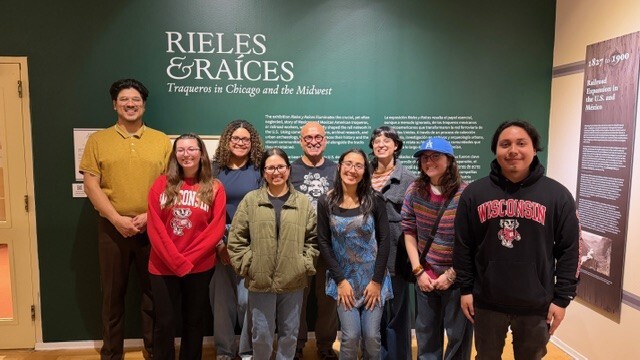
 On April 4th, 2026, CLS faculty and students took a field trip to Chicago to see two art exhibits. The first exhibit, titled “Rieles and Raíces,” was co-curated by an alumnus of the CLS Program, Ismael Cuevas (’10). Cuevas invited CLS faculty and students to come for a guided tour of the exhibit at the National Museum of Mexican Art in Chicago. Cuevas credits his experience with CLS with preparing him to work on this important exhibit. The second exhibit, located at the Museum of Contemporary Art in Chicago, was on the art of Dominican/Haitian artist Firelei Báez.
This field trip was well-received by students and faculty alike. For CLS Student Karla Martinez, “Rieles and Raíces” confirmed for her “that collecting and preserving our stories is important in filling the archival gaps.” She further noted that the exhibit also revealed “the importance of average working people in history, and telling these stories is equally important as telling the stories of major figures, politicians, and athletes.” Alicia Lopez highlighted the inspiring nature of the exhibit, as “viewers of this exhibit can and should make connections between now and the past when it comes to the public framing of immigrants and immigrant work forces.” What she found most impactful about the exhibit was “the history of fluctuating views regarding immigrants—how at some moments they are needed but at other moments, they are unwanted.”
CLS students were also inspired by Cuevas’ work on the exhibit. Adrian Angeles Ordoñez noted that what he appreciated about viewing “Rieles and Raíces” was “Ismael Cuevas’s story of creating the exhibit, how he brought the research story to life in the exhibit.” Alexa Iraheta praised the exhibit as “a beautiful commemoration to Latine railroad workers in the U.S.” She further complimented how the exhibit “honored the women and families who were the glue to making this exhibit possible because they were the ones who had kept these records, photos, etc.” After her experience on the field trip, she encourages “all museum goers to ask where the archives come from because the source is just as important as the archival material.” This field trip was enjoyed by all who had the opportunity to participate, and CLS hopes to offer more opportunities like this in the future.
On April 4th, 2026, CLS faculty and students took a field trip to Chicago to see two art exhibits. The first exhibit, titled “Rieles and Raíces,” was co-curated by an alumnus of the CLS Program, Ismael Cuevas (’10). Cuevas invited CLS faculty and students to come for a guided tour of the exhibit at the National Museum of Mexican Art in Chicago. Cuevas credits his experience with CLS with preparing him to work on this important exhibit. The second exhibit, located at the Museum of Contemporary Art in Chicago, was on the art of Dominican/Haitian artist Firelei Báez.
This field trip was well-received by students and faculty alike. For CLS Student Karla Martinez, “Rieles and Raíces” confirmed for her “that collecting and preserving our stories is important in filling the archival gaps.” She further noted that the exhibit also revealed “the importance of average working people in history, and telling these stories is equally important as telling the stories of major figures, politicians, and athletes.” Alicia Lopez highlighted the inspiring nature of the exhibit, as “viewers of this exhibit can and should make connections between now and the past when it comes to the public framing of immigrants and immigrant work forces.” What she found most impactful about the exhibit was “the history of fluctuating views regarding immigrants—how at some moments they are needed but at other moments, they are unwanted.”
CLS students were also inspired by Cuevas’ work on the exhibit. Adrian Angeles Ordoñez noted that what he appreciated about viewing “Rieles and Raíces” was “Ismael Cuevas’s story of creating the exhibit, how he brought the research story to life in the exhibit.” Alexa Iraheta praised the exhibit as “a beautiful commemoration to Latine railroad workers in the U.S.” She further complimented how the exhibit “honored the women and families who were the glue to making this exhibit possible because they were the ones who had kept these records, photos, etc.” After her experience on the field trip, she encourages “all museum goers to ask where the archives come from because the source is just as important as the archival material.” This field trip was enjoyed by all who had the opportunity to participate, and CLS hopes to offer more opportunities like this in the future.
 Spring 2026 Newsletter